Buy gewinnspiel.online ?
We are moving the project
gewinnspiel.online .
Are you interested in purchasing the domain
gewinnspiel.online ?
domain@kv-gmbh.de · 0541-91531010
Buy gewinnspiel.online ?
What is the biserial correlation coefficient and the phi coefficient and the chi coefficient?
The biserial correlation coefficient is a measure of the strength and direction of the relationship between a continuous variable and a dichotomous variable. It is calculated when one variable is continuous and the other is dichotomous. The phi coefficient is a measure of association between two dichotomous variables. It is calculated using a 2x2 contingency table and ranges from -1 to 1, with 0 indicating no association and 1 indicating a perfect association. The chi coefficient is a measure of association between two dichotomous variables, similar to the phi coefficient. It is also calculated using a 2x2 contingency table and ranges from -1 to 1, with 0 indicating no association and 1 indicating a perfect association. **
Which correlation coefficient?
The correlation coefficient is a statistical measure that quantifies the strength and direction of a relationship between two variables. It ranges from -1 to 1, with -1 indicating a perfect negative correlation, 0 indicating no correlation, and 1 indicating a perfect positive correlation. The correlation coefficient is used to determine how closely the two variables are related and can help in making predictions or understanding the nature of the relationship between them. **


Similar search terms for Coefficient
Top-Angebote
Products related to Coefficient:
-
GSE Games & Sports Expert GSE™ Brass Raffle Ticket Dispenser for Single or Double Roll Raffle Tickets Lotteries - YellowThe GSE brass raffle ticket dispenser is made of brass-plated steel, including a removable metal wire bar, used for both single and double ticket rolls, lightweight and easily portable, simple operation, not easily deformed or broken, durable. the...21,09 $*Shipping: 0,00 $Secure redirect to the provider
-
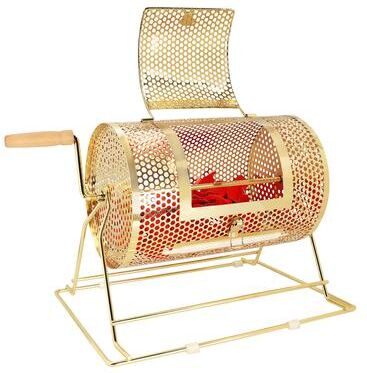
GSE Games & Sports Expert GSE™ Small Brass Raffle Ticket Drum - Holds 2,000 Tickets or 80 Ping Pong Raffle BallsThe GSE quality brass raffle drum made of heavy-duty steel with brass coating comes with a solid wood handle, a large trapdoor door, a rectangular steel bottom frame with a non-slip design keeping the raffle drum stable, and an updated toggle clamp...60,99 $*Shipping: 0,00 $Secure redirect to the provider
-
Tools, Home & Hobby Raffle Ticket Spinner Drum 2500 Capacity Lottery Drawing Cage For Events Raffle Ticket Spinner Drum 2500 Capacity Lottery Drawing Cage For EventsCreate unforgettable moments at every gathering with a reliable raffle ticket spinner designed to make drawings smooth, fair, and entertaining. This professional raffle drum holds up to 2,500 tickets or 100 ping pong balls, making it perfect for...97,97 $*Shipping: 0,00 $Secure redirect to the provider
-
Uplift Essentials Tabletop Dry Erase Prize Wheel Spinner Tabletop Dry Erase Prize Wheel SpinnerBring highenergy excitement, friendly competition, and interactive fun to any event with this dynamic prize wheel. Designed with a smoothspinning acrylic face divided into vibrant rainbow color slots, this dryerase game wheel lets you customize...58,97 $*Shipping: 0,00 $Secure redirect to the provider



-
What is the binomial coefficient?
The binomial coefficient, denoted as ${n \choose k}$, represents the number of ways to choose k elements from a set of n elements without regard to the order of selection. It is calculated using the formula ${n \choose k} = \frac{n!}{k!(n-k)!}$, where n! denotes the factorial of n. The binomial coefficient is commonly used in combinatorics and probability theory to calculate the number of combinations or possibilities in a given scenario. **
-
What is the Lusor coefficient?
The Lusor coefficient is a measure of the ability of a fluid to carry sediment. It is used in the field of sediment transport to quantify the sediment-carrying capacity of a fluid, such as water or air. The coefficient takes into account factors such as the size and density of the sediment particles, as well as the velocity and viscosity of the fluid. A higher Lusor coefficient indicates a greater ability of the fluid to transport sediment. **
-
What is the validity coefficient?
The validity coefficient is a statistical measure that quantifies the relationship between a predictor (such as a test or assessment) and a criterion (such as job performance or academic achievement). It indicates the degree to which the predictor is able to accurately predict the criterion. A higher validity coefficient suggests a stronger relationship between the predictor and the criterion, indicating that the predictor is more effective in predicting the criterion. Validity coefficients are commonly used in the field of psychometrics and are important for evaluating the effectiveness of selection tools and assessments. **
-
What is a Gini coefficient?
A Gini coefficient is a measure of income inequality within a population. It is calculated based on the distribution of income or wealth among individuals or households in a given country or region. The coefficient ranges from 0 to 1, with 0 representing perfect equality (everyone has the same income) and 1 representing perfect inequality (one person has all the income). A higher Gini coefficient indicates greater income inequality, while a lower coefficient indicates more equal distribution of income. **


What is the multiplication coefficient?
The multiplication coefficient is a number that represents the factor by which a quantity is multiplied. It is used to scale or increase the value of a quantity by a certain amount. For example, if the multiplication coefficient is 2, then the quantity is doubled. The multiplication coefficient is often used in mathematical equations and calculations to represent the relationship between different quantities. **
How is the Gini coefficient calculated?
The Gini coefficient is calculated by plotting the cumulative distribution of income or wealth against the cumulative share of the population. The coefficient is then derived by dividing the area between the line of perfect equality (where everyone has the same income or wealth) and the actual distribution curve by the total area under the line of perfect equality. The resulting value ranges from 0 (perfect equality) to 1 (perfect inequality). **
Top-Angebote
Products related to Coefficient:
-
Uplift Treasures Tabletop Prize Spin Wheel Interactive Giveaway And Party Game Accessory Tabletop Prize Spin Wheel Interactive Giveaway And Party Game AccessoryAdd instant excitement and interaction to any gathering with this fun and engaging Tabletop Prize Wheel designed for games, promotions, and celebrations. This compact spin wheel features an editable surface, allowing you to customize prizes,...93,97 $*Shipping: 0,00 $Secure redirect to the provider
-
Youfap Market Lottery Bingo Game Cage, Sweepstakes Tabletop Board Game For Large Parties Lottery Bingo Game Cage, Sweepstakes Tabletop Board Game For Large PartiesEnjoy Endless Fun with the Bingo Lottery Machine Cage The Bingo Lottery Machine Cage is the ultimate solution for family gatherings and large party entertainment. Designed to bring joy and excitement, this tabletop board game is perfect for anyone...44,97 $*Shipping: 0,00 $Secure redirect to the provider
-
GSE Games & Sports Expert GSE™ Brass Raffle Ticket Dispenser for Single or Double Roll Raffle Tickets Lotteries - YellowThe GSE brass raffle ticket dispenser is made of brass-plated steel, including a removable metal wire bar, used for both single and double ticket rolls, lightweight and easily portable, simple operation, not easily deformed or broken, durable. the...21,09 $*Shipping: 0,00 $Secure redirect to the provider
-
GSE Games & Sports Expert GSE™ Small Brass Raffle Ticket Drum - Holds 2,000 Tickets or 80 Ping Pong Raffle BallsThe GSE quality brass raffle drum made of heavy-duty steel with brass coating comes with a solid wood handle, a large trapdoor door, a rectangular steel bottom frame with a non-slip design keeping the raffle drum stable, and an updated toggle clamp...60,99 $*Shipping: 0,00 $Secure redirect to the provider
-
What is the biserial correlation coefficient and the phi coefficient and the chi coefficient?
The biserial correlation coefficient is a measure of the strength and direction of the relationship between a continuous variable and a dichotomous variable. It is calculated when one variable is continuous and the other is dichotomous. The phi coefficient is a measure of association between two dichotomous variables. It is calculated using a 2x2 contingency table and ranges from -1 to 1, with 0 indicating no association and 1 indicating a perfect association. The chi coefficient is a measure of association between two dichotomous variables, similar to the phi coefficient. It is also calculated using a 2x2 contingency table and ranges from -1 to 1, with 0 indicating no association and 1 indicating a perfect association. **
-
Which correlation coefficient?
The correlation coefficient is a statistical measure that quantifies the strength and direction of a relationship between two variables. It ranges from -1 to 1, with -1 indicating a perfect negative correlation, 0 indicating no correlation, and 1 indicating a perfect positive correlation. The correlation coefficient is used to determine how closely the two variables are related and can help in making predictions or understanding the nature of the relationship between them. **
-
What is the binomial coefficient?
The binomial coefficient, denoted as ${n \choose k}$, represents the number of ways to choose k elements from a set of n elements without regard to the order of selection. It is calculated using the formula ${n \choose k} = \frac{n!}{k!(n-k)!}$, where n! denotes the factorial of n. The binomial coefficient is commonly used in combinatorics and probability theory to calculate the number of combinations or possibilities in a given scenario. **
-
What is the Lusor coefficient?
The Lusor coefficient is a measure of the ability of a fluid to carry sediment. It is used in the field of sediment transport to quantify the sediment-carrying capacity of a fluid, such as water or air. The coefficient takes into account factors such as the size and density of the sediment particles, as well as the velocity and viscosity of the fluid. A higher Lusor coefficient indicates a greater ability of the fluid to transport sediment. **
Similar search terms for Coefficient
-
Tools, Home & Hobby Raffle Ticket Spinner Drum 2500 Capacity Lottery Drawing Cage For Events Raffle Ticket Spinner Drum 2500 Capacity Lottery Drawing Cage For EventsCreate unforgettable moments at every gathering with a reliable raffle ticket spinner designed to make drawings smooth, fair, and entertaining. This professional raffle drum holds up to 2,500 tickets or 100 ping pong balls, making it perfect for...97,97 $*Shipping: 0,00 $Secure redirect to the provider
-
Uplift Essentials Tabletop Dry Erase Prize Wheel Spinner Tabletop Dry Erase Prize Wheel SpinnerBring highenergy excitement, friendly competition, and interactive fun to any event with this dynamic prize wheel. Designed with a smoothspinning acrylic face divided into vibrant rainbow color slots, this dryerase game wheel lets you customize...58,97 $*Shipping: 0,00 $Secure redirect to the provider
-
Tools, Home & Hobby Brass Plated Raffle Drum With Large Capacity Ticket Spinning Cage And Wooden Handle Brass Plated Raffle Drum With Large Capacity Ticket Spinning Cage And Wooden HandleMake every draw feel exciting fair and easy to follow. This raffle ticket spinning cage combines a visible open design with smooth manual rotation so participants can watch entries mix before each winner is selected. Built from heavyduty steel with...139,97 $*Shipping: 0,00 $Secure redirect to the provider
-
GSE Games & Sports Expert GSE™ 2-Pack Brass Raffle Ticket Dispenser for Single/Double Roll Raffle Tickets Lotteries - YellowThe GSE brass raffle ticket dispenser is made of brass-plated steel, including a removable metal wire bar, used for both single and double ticket rolls, lightweight and easily portable, simple operation, not easily deformed or broken, durable. the...25,19 $*Shipping: 0,00 $Secure redirect to the provider
-
What is the validity coefficient?
The validity coefficient is a statistical measure that quantifies the relationship between a predictor (such as a test or assessment) and a criterion (such as job performance or academic achievement). It indicates the degree to which the predictor is able to accurately predict the criterion. A higher validity coefficient suggests a stronger relationship between the predictor and the criterion, indicating that the predictor is more effective in predicting the criterion. Validity coefficients are commonly used in the field of psychometrics and are important for evaluating the effectiveness of selection tools and assessments. **
-
What is a Gini coefficient?
A Gini coefficient is a measure of income inequality within a population. It is calculated based on the distribution of income or wealth among individuals or households in a given country or region. The coefficient ranges from 0 to 1, with 0 representing perfect equality (everyone has the same income) and 1 representing perfect inequality (one person has all the income). A higher Gini coefficient indicates greater income inequality, while a lower coefficient indicates more equal distribution of income. **
-
What is the multiplication coefficient?
The multiplication coefficient is a number that represents the factor by which a quantity is multiplied. It is used to scale or increase the value of a quantity by a certain amount. For example, if the multiplication coefficient is 2, then the quantity is doubled. The multiplication coefficient is often used in mathematical equations and calculations to represent the relationship between different quantities. **
-
How is the Gini coefficient calculated?
The Gini coefficient is calculated by plotting the cumulative distribution of income or wealth against the cumulative share of the population. The coefficient is then derived by dividing the area between the line of perfect equality (where everyone has the same income or wealth) and the actual distribution curve by the total area under the line of perfect equality. The resulting value ranges from 0 (perfect equality) to 1 (perfect inequality). **
* All prices are inclusive of VAT and, if applicable, plus shipping costs. The offer information is based on the details provided by the respective shop and is updated through automated processes. Real-time updates do not occur, so deviations can occur in individual cases. ** Note: Parts of this content were created by AI.